I put my own site through vaglio: from a C to an A in one afternoon
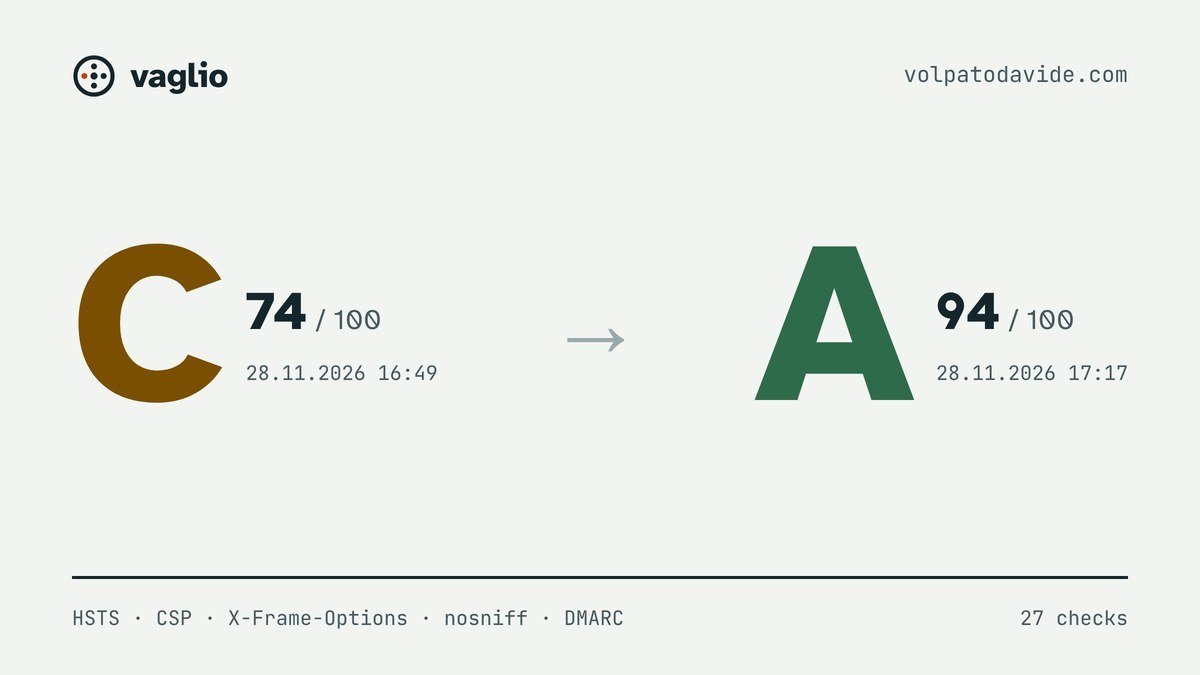
I built a security scanner. The first thing I did was point it at my own site.
Grade: C, 74 out of 100.
My site is static. No database, no login, no WordPress. I was sure I was fine.
Twenty-eight minutes later, the same scanner said A, 94 out of 100. In between, I found things no report had told me plainly.
The scanner is called vaglio. It’s free, open source, and it’s on GitHub.
What vaglio is
Vaglio is Italian for a sieve. Passare al vaglio, to put something through the sieve, means looking at it closely before you trust it.
It does two things:
- It checks a website the way a visitor’s browser sees it: 27 passive checks, a grade, and the fixes in order of importance, with the configuration ready for your host.
- It checks code on your own computer: folders, apps, browser extensions. It looks for forgotten keys, seed phrases, wallet secrets leaving the device, extensions with too many permissions. It sends nothing anywhere.
It runs on fixed rules. No AI required, no account, no API key. Same input, same result, every time.
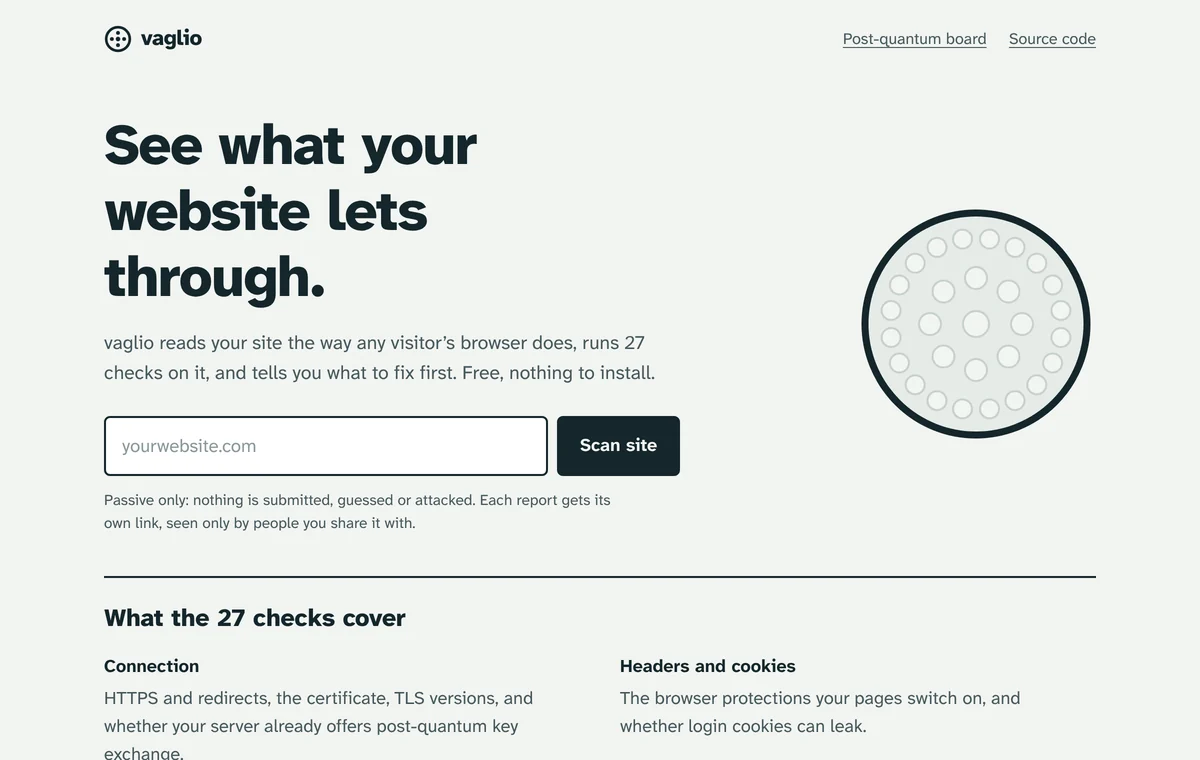
vaglio reads a site the way a visitor’s browser would. It submits nothing, guesses nothing, attacks nothing.
The grade counts fixes, not pages
Another scanner, a paid one, gave the same site 43 out of 100 and 301 findings. Almost all of them were the same missing headers, counted once for each of the 47 pages it read.
vaglio lists each problem once, however many pages share it. The maths is in the README: 100 minus 35 for each critical problem, 15 for each high, 6 for each medium, 2 for each low. A single critical problem means F.
Five fixes are five fixes. Not 301.
What it found
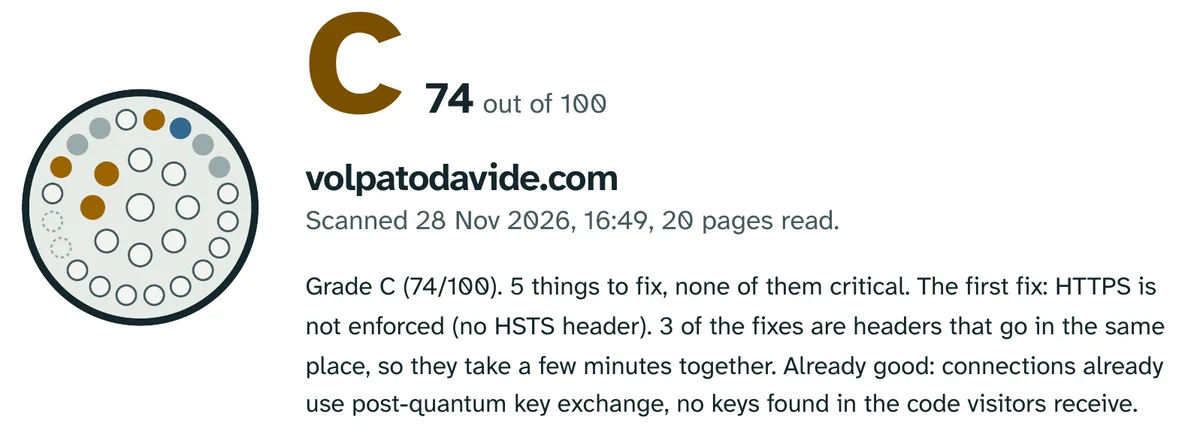
The first report: C, 74 out of 100. Nothing critical, five things to fix.
Five things, none critical:
- HTTPS not enforced: the HSTS header was missing.
- Clickjacking: any site could load my pages inside an invisible iframe.
- A Content-Security-Policy that doesn’t restrict scripts: there was one, but all it did was tell the browser to use https.
- No DMARC policy for the domain’s email.
- X-Content-Type-Options missing: the browser could guess file types.
The interesting part came next.
The rules were there. The server wasn’t using them
I had already written the headers, in the .htaccess file. The server wasn’t applying them. I noticed because the old WordPress addresses, which the same file was meant to redirect, returned 404.
.htaccess starts with a dot, so on a Mac it’s a hidden file. In manual uploads it’s the first thing to get lost. Now the site publishes itself: every push to GitHub runs an Action that builds the pages and sends them live, .htaccess included.
The host’s 404 page was tracking visitors
Without .htaccess, the server showed its own default error page instead of mine. That page loads Google Analytics and DoubleClick.
My site uses no cookies and no tracking. Anyone who mistyped an address was tracked anyway, by someone else.
The source code was online
On the first upload, the project’s folders had landed on the server along with the site. No passwords in them, but code from a private repository was readable by anyone who knew the path. I deleted them.
A script tag in a 2019 article
To write a serious Content-Security-Policy you need to know which scripts run on your site. So I took an inventory of all 116 pages.
In an old article about the Facebook Pixel, migrated from WordPress, the code examples had turned into real HTML. An fbq() call was actually running, and half a sentence vanished inside a <script> tag, invisible to readers. No scanner tells you that: you only find it if you go and look.
How I fixed it
The headers are six lines:
Header always set Strict-Transport-Security "max-age=31536000"
Header always set X-Content-Type-Options "nosniff"
Header always set X-Frame-Options "SAMEORIGIN"
Header always set Referrer-Policy "strict-origin-when-cross-origin"
Header always set Permissions-Policy "camera=(), microphone=(), geolocation=(), payment=(), usb=()"
Header always set Content-Security-Policy "script-src 'self'; object-src 'none'; base-uri 'self'; form-action 'self'; frame-ancestors 'self'; upgrade-insecure-requests"
Three choices, and why:
- HSTS without
includeSubDomains. One subdomain only answers over HTTP: withincludeSubDomains, browsers would have stopped opening it, for a year. - Scripts only from my own domain, no exceptions. Instead of adding
'unsafe-inline', I moved the two small scripts that lived inside the pages into files. Then I loaded all 116 pages with the policy on: zero violations, zero errors. - YouTube videos stay. The policy restricts scripts, not iframes, so the videos embedded in articles still work.
For DMARC, a TXT record at _dmarc is enough. Start with p=none and a report address you actually read, then tighten it.
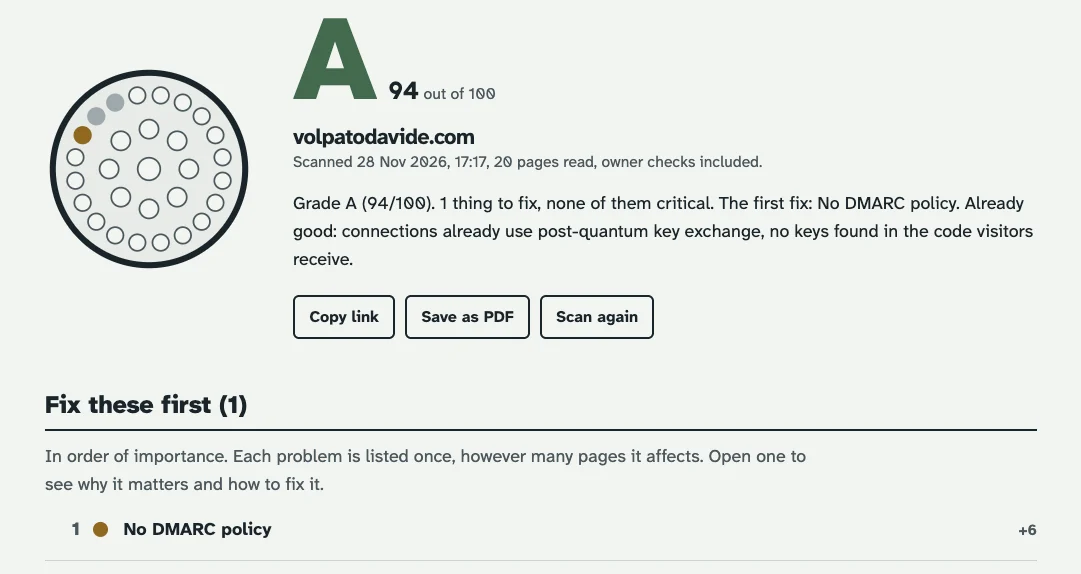
Twenty-eight minutes later: A, 94 out of 100. Only the DMARC record was missing, added right after.
What I didn’t do, on purpose
vaglio also suggests a CAA record, which says which authorities may issue certificates for the domain. The suggestion was to allow Let’s Encrypt.
But one of my subdomains runs on Cloudflare, and its certificate comes from Google Trust Services. With that record, it would have stopped renewing. Advice that’s right in general can break something of yours: the scanner tells you where to look, the decision stays yours.
Post-quantum already matters today
One thing my site was already doing right, without me lifting a finger: its connections use post-quantum key exchange.
Why it matters now has a name: harvest now, decrypt later. Anyone recording encrypted traffic today can keep it and decrypt it the day a quantum computer breaks classical cryptography. To protect that traffic, the key exchange has to hold up already today.
The group that does it is called X25519MLKEM768: it combines the classical X25519 curve with ML-KEM, NIST’s post-quantum standard. Current browsers already offer it. The server has to accept it too.
That’s why vaglio also keeps a board: banks, exchanges, wallets and payment companies, checked from the outside the way a browser connects. First measurement, from Dubai, on 27 November 2026:
- 43 of 57 sites already accept post-quantum key exchange.
- Wallets and DeFi: 13 of 13.
- Exchanges: 13 of 16.
- Payments and fintech: 8 of 12.
- Banks: 9 of 16.
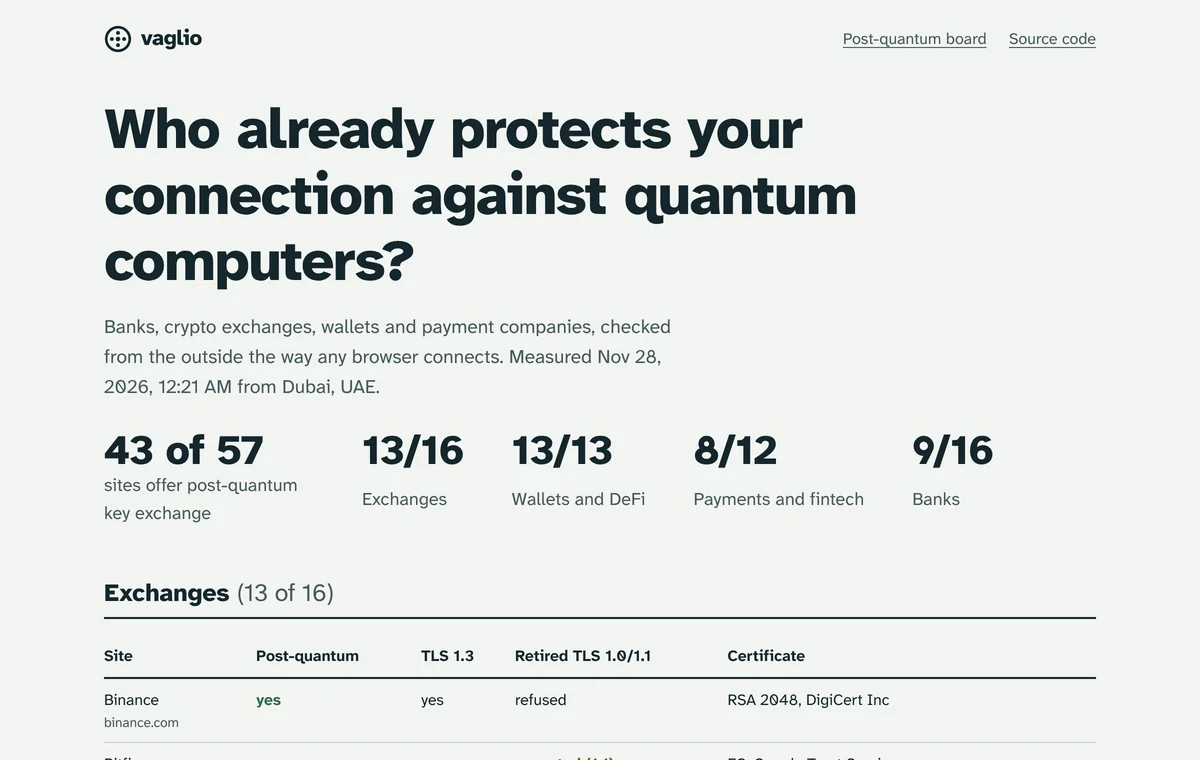
Crypto is ahead of the banks.
Two caveats. It’s a measurement from a single place, and large sites sit behind CDNs that can answer differently from another country. And it’s about key exchange, not certificates: the 57 sites’ certificates are all classical, RSA or elliptic curves. Certificates prove identity only at the moment of connection, so they can’t be attacked after the fact: they can wait. Key exchange can’t.
What it does with code
The other half of vaglio runs only on your computer:
node bin/vaglio.js scan ./my-project     # a folder of code
node bin/vaglio.js scan ./wallet.apk     # an app or extension: .apk .ipa .crx .zip .xpi
node bin/vaglio.js extensions            # every browser extension installed
It answers four questions:
- Is a wallet secret leaving the device? Seed phrases or private keys inside network requests, stored in clear, or printed to logs.
- Did someone leave keys in the code? Seed phrases are checked against the BIP39 checksum: if they pass, they’re a real wallet.
- What can this browser extension do? Access to every site, the clipboard, cookies, code loaded from outside.
- How far is this from post-quantum? An inventory of the cryptography the code uses: what to migrate one day, what’s already post-quantum, what’s weak even today.
Trying it on a real wallet extension, built on a widely used open-source wallet, it turned up a “critical” seed phrase along with several private keys. They were the original project’s test data, shipped in the published package. A false alarm for the wallet, a real cleanup problem. Since then vaglio recognises test data and leaves it out of the grade.
It also plugs into GitHub as an Action: results land in the repository’s Security tab, and the build stops if it finds something serious.
The limits, in plain words
- It’s a screening, not an audit. An A doesn’t prove you’re safe: it proves you haven’t left obvious doors open.
- It works on names and distance; it doesn’t follow data from one function to another. Code written to hide will hide.
- The website check reads pages as they arrive: scripts added later by a tag manager are not seen.
- If you find a problem in someone else’s software, tell the authors privately first and give them time to fix it.
How it’s built, for developers
- Node.js 20 or newer, zero dependencies. Under 5,000 lines.
- Fixed rules, no models. If you set an Anthropic key, Claude writes only the summary paragraph: the grade never depends on it.
- A public scanner is a risk, because anyone can make it open any address. vaglio accepts only http and https on ports 80 and 443, and checks the address again on every redirect: private networks, localhost and cloud metadata are never reached.
- Owner checks (files that should never be public, databases anyone can read) run only after a TXT record proves the domain is yours. Tables are asked only for their row count: no data is ever downloaded.
Try it
git clone https://github.com/Amaraciuri/vaglio.git
cd vaglio
node bin/vaglio.js site yoursite.com    # the website check, in the terminal
npm start                               # the web page, at http://localhost:8080
It’s free, under the MIT licence. Put your site through vaglio.
If you find something vaglio misses, open an issue on GitHub or find me on LinkedIn or X.